
The myth of price promotions
What does a company aim to achieve by reducing its prices for all customers for a limited time? To evaluate such actions more critically, it is useful to understand when a promotion is a good pricing tactic and when it is merely an expense on a company's income statement.
PROMOTIONS

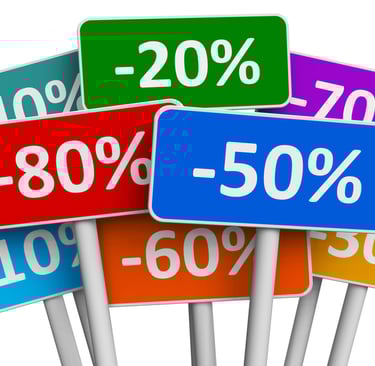
It is hard to open a newspaper, walk down the street, or turn on the TV or radio without seeing a promotion. We are referring to short-term promotions such as “Buy 1, get 2 this week” or “50% off TODAY.” These appear across all categories, from mass consumer goods to industrial services and luxury items. But have we ever asked ourselves: does this promotion make sense? What does the company hope to achieve by lowering prices for all its customers for a set period? To judge these actions more critically, it is important to understand when a promotion is an effective marketing tactic and when it is just an expense on the company’s financial statements.
Valid Promotions
There are basically three cases in which promotional discounts are a good marketing tool. The first is when launching a new product. Since companies need to minimize the risk for buyers trying a new brand, they should offer launch prices lower than usual. In personal care categories, such as deodorants, this tactic is common for introducing new products. Only with free samples or sufficiently low prices would the average consumer try a new brand. Once the promised benefits are verified, the buyer decides if future purchases will continue with the new product. In this way, each new product sold contributes marginally, although any potential cannibalization of existing brands should be accounted for. Note that for undifferentiated products (commodities), promotions are unlikely to attract new buyers; a person who buys brand X sugar will not switch to brand Y just because they received a free sample once.
The second valid case is when a company aims to penetrate new market segments (geographic, demographic, etc.) or expand its current segment. It is critical to ensure that promotional sales do not replace existing sales and harm product line contribution. For example, if a gym opens a new location, offering promotional prices or free passes to try the facilities is a good strategy. A portion of new users will stay permanently, contributing marginal revenue. Conversely, if the goal is to attract new customers to an existing location, a mass promotion could also reach current customers, harming overall contribution. Ensuring that promotions are marginal and applied only to new customers increases their effectiveness.
The third reason to use promotions is inventory management, both for the company and for channels or end customers. Promotions to clear obsolete or perishable stock are excellent options to avoid losing already-paid merchandise. Clothing retailers, outlets, and end-of-season sales are examples. Price promotions can also be defensive against new competitors, encouraging channels or end customers to buy in advance and increase inventory, temporarily reducing market demand and hindering competitor entry.
Invalid Promotions
Now let’s consider two cases where promotions are not wise. The first, most common case is a defensive response to a new competitor entering a mature market. While a promotion may make sense for a new entrant to gain trial, it usually does not for the established brand to match prices. Only a portion of loyal customers will respond to the competitor’s promotion, and it’s impossible to know which ones. A mass promotion then impacts all users, hurting contribution. Regular discounts in mature markets can also erode brand image and increase price sensitivity among previously less sensitive customers. Frequent promotions from large retailers have trained consumers to constantly compare offers and reduce store loyalty.
The second and more dangerous case is frequent, short-term promotions in mature markets to create a perception of permanent savings. As markets mature, consumers become more informed and price-sensitive. Occasional discounts do not convince truly price-sensitive buyers, who will switch brands seeking the weekly deal. Frequent, periodic promotions can shift purchases to promotional periods, destroying category value. This was evident in Colombia’s long-distance telephony market during its decline in 2003, following aggressive price promotions by new entrants after market liberalization in 1998. While these promotions helped new operators gain critical user mass, continued promotional activity in a mature market was detrimental.
The Million-Dollar Question
How can companies create a perception of permanent savings in mature markets? How can they serve price-sensitive customers without destroying value for those willing to pay more? Companies like Cine Colombia, defending against Cinemark, or Wal-Mart, surpassing K-Mart, have found the answer. They focus on being economical with essential customers and maintaining discipline. The necessary tools are price segmentation and Revenue Management.
In Summary...
Promotions should be used for product launches, market segment penetration, or inventory management. Question any promotion that deviates from these objectives, especially mass, unsegmented campaigns. Price is the easiest variable to use and immediately impacts sales, but if misused, it can severely harm a company’s income statement.
©2026, prexus pricing solutions
[email protected] | +57 (604) 204 3151
Cra 43A No. 1-50, Torre 1, Piso 6
Medellín, Colombia
Legal
Personal data processing policy
Terms and conditions
Information security policies