
Retail pricing strategies
Does it make sense for the retail chain J.C. Penney to change its traditional high-price, high-promotion strategy to a low-price, every-day approach? An analysis of the main retail pricing strategies, attempting to answer this question.
RETAIL

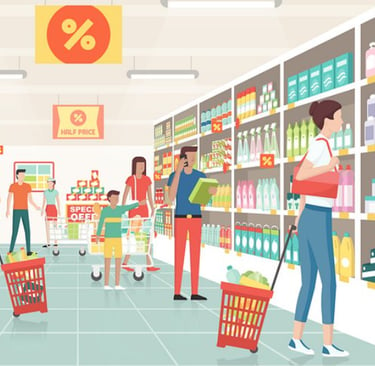
The American retail chain J.C. Penney has just announced a radical shift in its pricing strategy. They have decided to eliminate the hundreds of price promotions they run every year, aiming for a simpler and more predictable strategy for customers. The change includes a general price reduction across all merchandise by at least 40%, so customers no longer have to wait for sale days to find low prices. For example, a women's blouse that previously cost $14.99 will now be priced at $7.00.
Is this change in strategy a good idea? Does it make sense for this chain to switch from its traditional high-price, high-promotion strategy to a low-price, every-day approach? To answer these questions, it is necessary to first understand the differences between the two main retail pricing strategies: Hi-Lo and EDLP.
Understanding Hi-Lo
The first strategy arose from retailers' need to differentiate themselves from competitors. They used price as a differentiator by periodically reducing the price of certain products. The goal was to attract price-sensitive customers to their stores so that, once inside, they would also purchase other products that were not on sale.
This strategy is known as Hi-Lo and is characterized by high regular prices (Hi) with frequent price promotions on some products in the assortment (Lo). It is especially attractive to customers who make small purchases and have enough time to visit multiple stores. Additionally, this strategy aims to serve both price-sensitive and less price-sensitive customers under the same roof.
However, this only works if the two types of shoppers are effectively segmented. In the United States, where the use of discount coupons is culturally entrenched, a valid price segmentation can be achieved using this tool, as only the most price-sensitive customers take the time to search for coupons of interest in the endless catalogs delivered daily to their mailboxes.
In most Latin American countries, however, the Hi-Lo strategy is implemented through promotions on special days, such as “Liquor Fridays” or “Barbecue Saturdays.” If most customers buy liquor on Fridays or meat for barbecues on Saturdays, low prices end up being offered to everyone, both price-sensitive and less sensitive customers.
Every-day low prices
On the other hand, the “every-day low prices” (EDLP) strategy was designed for the large segment of highly price-sensitive buyers who do not have time to visit multiple stores looking for daily deals. This strategy is ideal for customers who make large purchases and want the guarantee of low prices every time in the same store.
Unlike Hi-Lo, this strategy does not serve customers with different levels of price sensitivity at the same location. Adopting this strategy must be linked to a large market segment valuing the convenience of making all purchases in one place, and to the retailer having sufficiently low operating costs compared to competitors. U.S. retailer Wal-Mart and Chilean Sodimac are examples of chains that have successfully adopted this strategy.
Shoes to their feet
Given this, does it make sense for J.C. Penney to switch from Hi-Lo to EDLP? First, the shift must involve a change in the chain’s positioning. J.C. Penney has designed a major repositioning campaign, including messages against the “invasion of coupons” in U.S. mailboxes. Another factor to consider is whether the new strategy aligns with the retailer’s internal capabilities.
To successfully adopt an EDLP strategy, a retailer must have some competitive cost advantage that allows offering low prices consistently without sacrificing return on investment. Since J.C. Penney has traditionally competed using a Hi-Lo strategy, where operational excellence is less critical, it remains to be seen if it can adapt its cost structure to the new strategy.
Finally, it is important to analyze whether the target customers are truly time-constrained buyers who prefer to make all their purchases in one place. Otherwise, their broad customer base may prefer to hunt for deals at another Hi-Lo retailer with an aggressive promotional calendar.
In summary...
It is not entirely clear if this strategy change is truly a good idea for J.C. Penney. In fact, some empirical studies suggest it is easier to profitably move from EDLP to Hi-Lo than the other way around, as J.C. Penney is attempting. The key takeaway is that choosing a retail pricing strategy is not a matter of trends but of understanding which strategy best fits the desired positioning, internal capabilities, and target market of the retailer.
©2026, prexus pricing solutions
[email protected] | +57 (604) 204 3151
Cra 43A No. 1-50, Torre 1, Piso 6
Medellín, Colombia
Legal
Personal data processing policy
Terms and conditions
Information security policies