
Pricing and RGM governance: How to eliminate friction between Marketing, Sales, and Finance
When a pricing strategy doesn’t work, it is almost never due to a lack of data. Usually, it’s the result of an opaque process, managed like a black box by a guru who controls an Excel file, without ensuring the active participation of the other areas of the business.
PRICING PROCESS
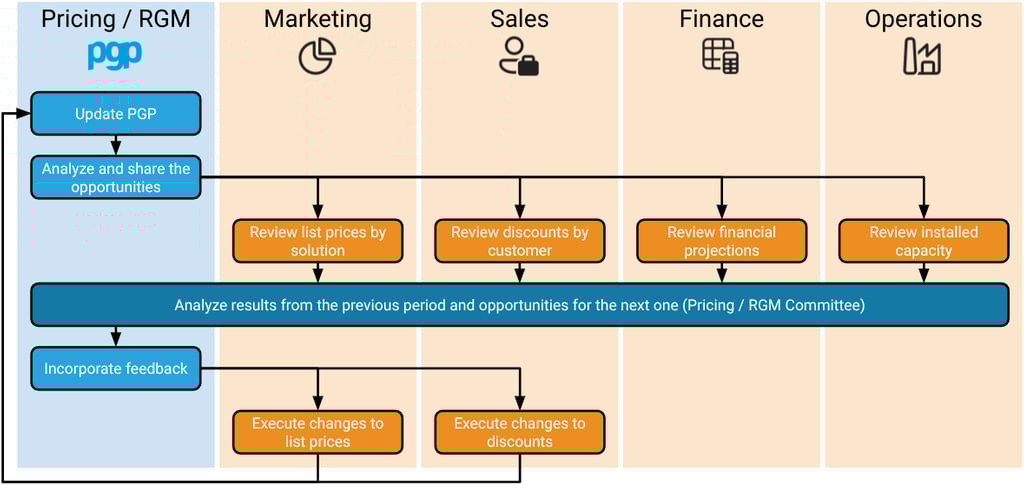
In most organizations, Finance chases a margin, Marketing defends a specific positioning, Sales negotiates discounts to save the month’s closing, and Operations tries to produce at any cost. This lack of alignment is not accidental: it’s the result of not having a clear process.
Based on our experience in organizations across different sectors, at prexus pricing solutions we have seen that a robust and sustainable pricing process works as follows:
1. Pricing / Revenue Growth Management: the starting point of the process
The Pricing/RGM team does not “dictate” prices by decree. Its role is to prepare the information so the business can decide with sufficient criteria.
Its initial tasks are:
Measure the results of the pricing decisions made in the previous period.
Update the pricing model with internal information (current units and net sales, costs, etc.) and external market data (perceived value, competitor prices, price elasticity, etc.).
Identify and analyze concrete opportunities in list prices by product and discounts by client.
Prepare scenarios and project expected financial results from the proposed price and discount adjustments.
2. Multifunctional validation: each area contributes a piece
The Pricing/RGM lead shares the opportunities with the other areas of the organization, so each can reconcile them with their strategic objectives:
Marketing: Validates whether list prices are aligned with the value proposition and positioning of each solution.
Sales: Reviews the discount structure by client and evaluates risks in key accounts.
Finance: Reviews the impact on financial results.
Operations: Confirms whether installed capacity supports the proposed scenarios.
When this step doesn’t occur, the committee becomes a debate without data. When it does occur, the committee becomes a decision-making space.
3. The Pricing / RGM Committee: where decisions are made
All teams meet in the Pricing/RGM committee to analyze the results of the previous period and evaluate the opportunities for the next one.
It’s not an informational meeting; it’s a meeting to make decisions:
What should we adjust in our strategy based on the previous period’s results?
What adjustments should we make to the list prices of each solution?
Which gaps do we commit to closing during this period in our clients’ commercial terms?
Is the financial projection consistent with the business’s short-, medium- and long-term goals?
The key is that all areas arrive prepared. They don’t defend territories—they share a common vision.
4. Closing gaps and execution
Based on the decisions made in the committee, the Pricing/RGM team incorporates the observations and updates the projected results of the selected scenario.
Then the decisions are executed:
Marketing/Pricing apply changes to the list prices of each solution.
Sales applies discount changes in client management.
Decisions turn into execution, not just a PowerPoint.
5. A continuous cycle, not an annual exercise
The market changes. Costs change. Competitors react. That’s why Pricing and RGM governance is cyclical: monthly, quarterly, or semiannual, depending on market dynamics.
The annual price review is an obsolete practice that must be avoided at all costs.
Result
When all areas of the organization contribute to the same analysis, working in a coordinated manner, the outcome is clear:
Well-founded prices
Coherent discounts by client
Less friction between areas
Higher profitability and faster execution
Price speaks about your product. Your pricing process speaks about the maturity of your organization.
©2026, prexus pricing solutions
[email protected] | +57 (604) 204 3151
Cra 43A No. 1-50, Torre 1, Piso 6
Medellín, Colombia
Legal
Personal data processing policy
Terms and conditions
Information security policies