
Price as a profitability lever
Of the four levers that exist to increase operating profit (price, volume, variable costs and fixed costs), price is the most powerful. In Colombia, a 1% increase in the average price, keeping the other levers stable, generates almost five times more impact on operating profit than a 1% reduction in fixed costs.
COSTSPROFITABILITY
In 2003, the prestigious consulting firm McKinsey published a study on the impact of price on the operating profitability of the world’s 1,200 largest companies. It concluded that, on average, a 1% increase in price generates an 11% improvement in operating profitability, if the other variables remain stable (variable costs, volume, and fixed costs). This result becomes even more relevant when compared to the impact generated by the other “profitability levers”: reducing variable costs, increasing volume, or reducing fixed costs by 1% results in improvements in operating profitability of 7%, 4%, and 3% respectively, again assuming that the other variables remain stable. These results are compelling regarding the power of price as a profitability lever. However, at least three questions arise when attempting to adapt these results to the local environment: How does the cost structure of companies influence the results? Is price equally powerful across all sectors of the economy? What would the results be when evaluating the combined effect of variations in price and volume? This article seeks to answer these three questions.
The Colombian case
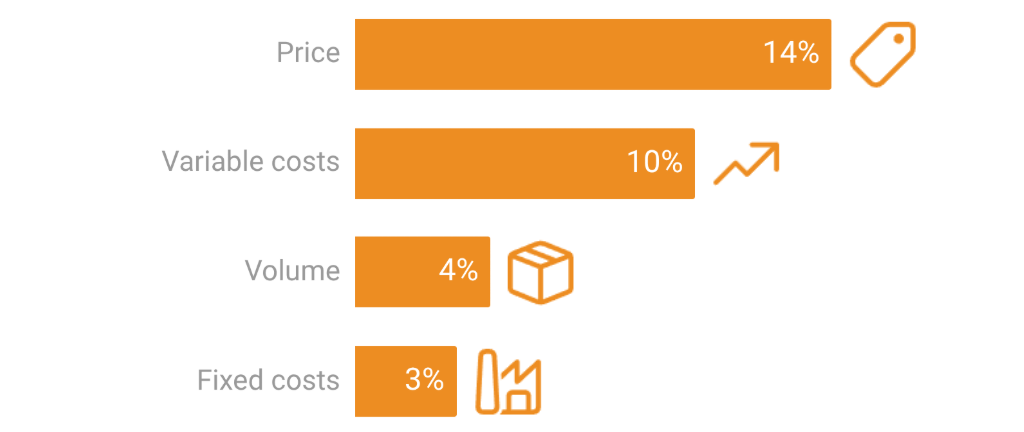
To adapt McKinsey’s original study to the Colombian economic reality, information from twenty of the main economic sectors was used. In this case, the results are even greater: A 1% price increase generates a 14% rise in operating profit, while the impact of the other levers (variable cost, volume, and fixed costs) is 10%, 4%, and 3% respectively. This difference in results in Colombia compared to the global average is explained by the difference in the cost structure of the companies evaluated: while the average operating margin of companies in Colombia is 7%, in the rest of the world it is 9%. And the lower this indicator is, the greater the positive impact of the profitability levers.
This last phenomenon sets the stage for answering the second question: the lower the operating margins of a sector, the greater the relative improvement in profitability obtained after increasing prices. Thus, in low-margin sectors such as retail and food, a 1% increase in average price can generate increases in operating profit of up to 37%. Conversely, the impact of price—and in general, of all profitability levers—is lower in high-margin sectors such as financial services and beverages. However, even in these latter cases, the positive impact of price generally doubles that of the other profitability levers.
Raising prices without losing sales
But is it possible to increase a company’s average price without losing volume? A microeconomics purist would say it is not. However, by leveraging differences in price elasticity among the various products or services in a company’s portfolio, it is possible to raise the average price without affecting volume. What’s more, with a good pricing strategy, it is possible to increase the average portfolio price while also achieving volume growth, even in times of crisis when the market contracts. This is achieved by understanding the role each product or service plays within the company’s portfolio, adjusting the pricing of existing offers, and creating solutions for new segments. In this way, by implementing an appropriate pricing strategy, it is possible, on average, to obtain increases of more than 14% in operating profit after a 1% price increase.
In summary...
In times of economic slowdown, most companies tend to cut costs and expenses to improve the bottom line of their income statement. These actions generally affect the level of investment companies must make to compete in the short and medium term. It is therefore important to recognize that there is an alternative, not only more effective but also more efficient, to improve a company’s profitability: price. Cost reduction not only generates smaller increases in operating profit but also accelerates the downward spiral of the economy in times of crisis. Price, on the other hand, allows for quick and sustainable results, while helping create value in the market.
©2026, prexus pricing solutions
[email protected] | +57 (604) 204 3151
Cra 43A No. 1-50, Torre 1, Piso 6
Medellín, Colombia
Legal
Personal data processing policy
Terms and conditions
Information security policies