
How to design a discount menu for customers?
In the structure of a price, the list price menu defines what is charged per product, while the discount menu determines what each customer actually pays. This second menu is key to encouraging behaviors that help sell more or reduce operating costs.
DISCOUNTS MENU
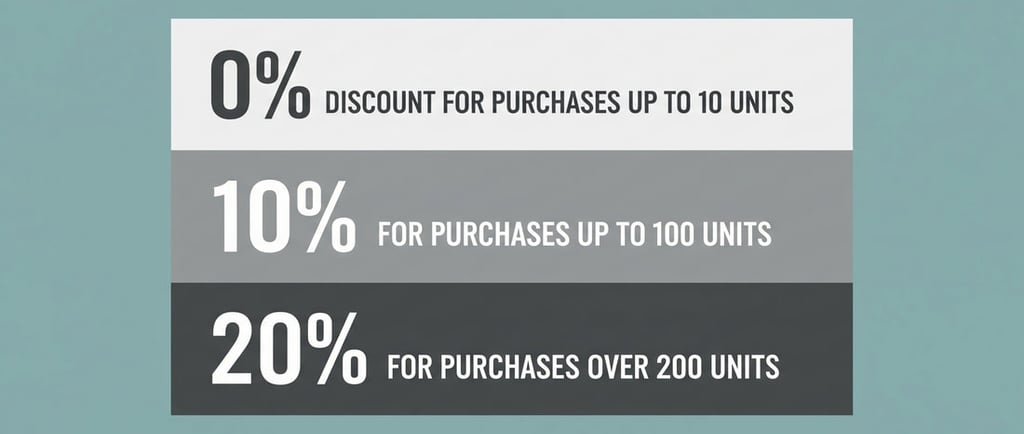
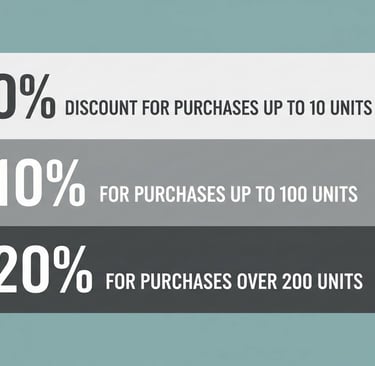
The discount menu is based on offering incentives to customers who voluntarily meet certain conditions. Some of these conditions are aimed at increasing sales. For example: monthly purchase volume, the number of products purchased from the portfolio, point-of-sale coverage, display quality, exclusivity with our products, or inventory turnover.
Other conditions are focused on reducing the cost to serve the customer. Some of these include: placing orders online, consolidating large orders instead of small ones, providing sales information, picking up at the plant, scheduling orders in advance, or paying upfront.
These conditions must not be imposed. Customers should choose them voluntarily if they consider the economic benefits offered attractive enough.
An example of a discount menu
Let’s consider an example combining three discount concepts applied to the list price. The first is based on the functions performed by the distributor:
Type A distributors provide display, demonstration, and post-sales technical support.
Type B distributors offer display and demonstration, but without technical support.
Type C distributors fulfill only a logistical function.
The second discount concept is associated with monthly purchase volume, with three ranges: more than $10,000, between $5,000 and $10,000, and less than $5,000.
The third concept is based on payment terms, which can range from 60 days to cash payment.
By combining these conditions, discounts ranging from 14% to 50% off the list price can be obtained.
How to negotiate using the menu
Suppose a type B customer, with a medium purchase volume and paying in 30 days, has a 33% discount. If they request a higher discount, you can offer clear alternatives:
If they pay in cash, they get two additional points.
If they replace purchases currently made from competitors with purchases from our company, they could obtain 10 more points.
If they take on additional functions and become a type A distributor, they receive five additional points.
These alternatives allow the customer to access a higher discount voluntarily, in exchange for conditions that benefit the company.
Complex menus: modular or hybrid format
When there are many variables, such as in the case of a company manufacturing chemical inputs, a matrix format is no longer practical. Instead, modular or hybrid formats are more efficient.
In this example, the discount menu includes eight concepts: customer type, quarterly volume, container returns, order size and scheduling, number of products purchased, payment terms, and level of commercial attention. Each variable has several options with specific discount premiums.
These premiums are added arithmetically to calculate the total discount. The maximum possible is 21.5%, achievable only if the customer meets all conditions.
The risk of not having a discount menu
When there is no formal menu and arbitrary discounts are applied, salespeople learn to close deals by lowering prices instead of building value to increase the customer’s willingness to pay.
Implementing a menu should be gradual. Customers need to understand that if they want a lower price, they must be willing to give something in return.
We have already explored how to use menus to offer options. The next step is to understand how to use these menus to balance supply and demand in capacity-constrained environments.
©2026, prexus pricing solutions
[email protected] | +57 (604) 204 3151
Cra 43A No. 1-50, Torre 1, Piso 6
Medellín, Colombia
Legal
Personal data processing policy
Terms and conditions
Information security policies