
How much do consumers really care about price?
The fourth edition of this study conducted by PREXUS reveals that the price sensitivity of Colombian consumers has normalized to the level prior to the entry of hard discount stores.
PERCEIVED VALUEPRICE SENSITIVITYBUYER TYPES
Since 2013, prexus has been conducting a study every two years to determine how much consumers care about price in the five main cities of Colombia, across five mass consumption categories—clothing, shampoo, sliced bread, potato chips, and rice. This fourth edition allows us to identify how consumer purchasing behavior has changed in the analyzed cities and categories.
Types of buyers
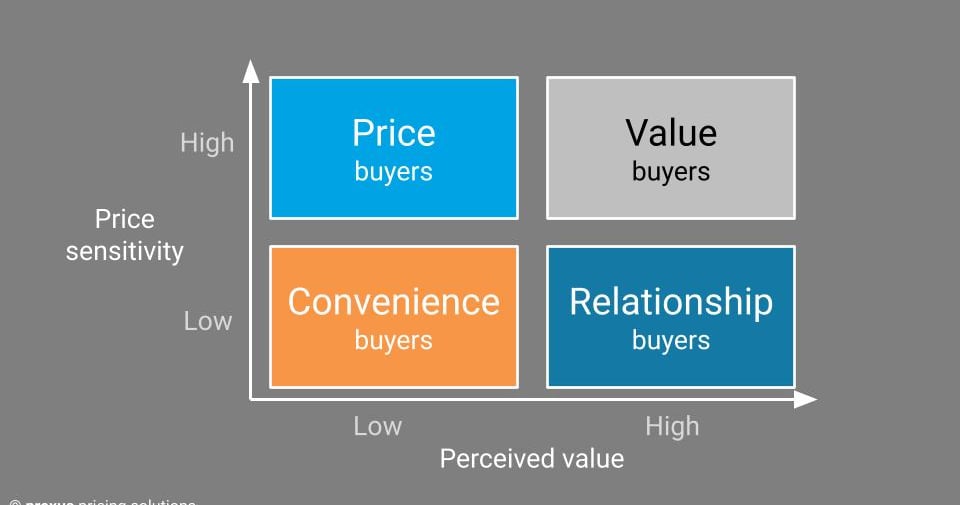
It is important to remember that, in any market, whether product or service, mass or industrial, there are four types of buyers. First, there are relationship buyers, who purchase the same brand from the same place as always because they like it and have never had problems with it.
Next are convenience buyers, who seek comfort by going to the nearest place and do not give much importance to price or other product aspects. Third are value buyers, who compare the different options available and choose the one that offers the best cost-benefit ratio.
Finally, there are price buyers, who look for the product with the lowest price and do not consider other aspects. It is precisely these last two types—value and price—that are commonly called “highly price-sensitive.” Quantifying their proportion within the market can be very helpful for companies to define their pricing strategies and avoid leaving money on the table.
More relationship and convenience buyers
This fourth study shows a normalization in consumer price sensitivity, similar to 2013—prior to the boom of hard discount stores.
On average across the five analyzed categories, the proportion of consumers who say they compare prices to make purchase decisions went from 25% in 2013, to 40% in 2015, then fell to 37% in 2017, and finally returned to 27% in 2019.
One hypothesis that could explain the reduction of relationship and convenience buyers in 2015 and 2017 is the impact of the proliferation of low-price stores—D1, Ara, Mercadería Justo y Bueno, etc. Purchases that were previously made only for proximity and convenience in residential neighborhoods could now be made by comparing prices across more options.
Once buyers accustomed to the new stores stopped comparing prices, they returned to purchasing mechanically, behaving again as relationship and convenience buyers.
However, the proportion of price-sensitive buyers is not uniform across all cities and socioeconomic strata. While in Cali and Medellín only 23% of buyers report comparing prices, in Barranquilla, Bogotá, and Bucaramanga this proportion is 32%.
At the socioeconomic strata level, it is not surprising that the proportion of price-sensitive buyers is higher in the lower strata (2 and 3). However, it is noteworthy that the higher strata (5 and 6) demonstrate greater price sensitivity than the middle class (stratum 4). This is usually explained by their lower risk aversion in trying new brands, seeking low prices.
In summary...
These results continue to show that consumers are less price-sensitive than most companies believe—almost half of consumers behave as relationship buyers, purchasing the brand they always buy without comparing prices.
When companies run mass promotions, they are selling cheaply to three out of four consumers whose purchase decisions are not motivated by price. For this large majority of consumers, it is crucial to invest in brand positioning to stay top-of-mind and maximize distribution to be found at the moment of purchase.
Finally, the greater price sensitivity of the remaining 27% of consumers makes it more relevant than ever to work on price segmentation to remain competitive among value and price buyers, without leaving money on the table with relationship and convenience buyers.
©2026, prexus pricing solutions
[email protected] | +57 (604) 204 3151
Cra 43A No. 1-50, Torre 1, Piso 6
Medellín, Colombia
Legal
Personal data processing policy
Terms and conditions
Information security policies